Of all the changes people notice in the lower face, marionette lines are among the ones that bother them most. They can lend the face a downturned, slightly sad or stern expression even when you feel nothing of the sort, which is exactly why people tend to want to understand them. If you have been wondering what causes marionette lines, the short answer is that they are the result of several things happening at once, and knowing which of them applies to you is the key to identifying the correct treatment you may benefit from.
At The Bronte Clinic, marionette lines are a lower-face concern we know well. The reassuring thing is that they respond to a considered, non-surgical approach, provided the treatment is matched to the underlying cause rather than simply filling the line and hoping.
What Causes Marionette Lines?
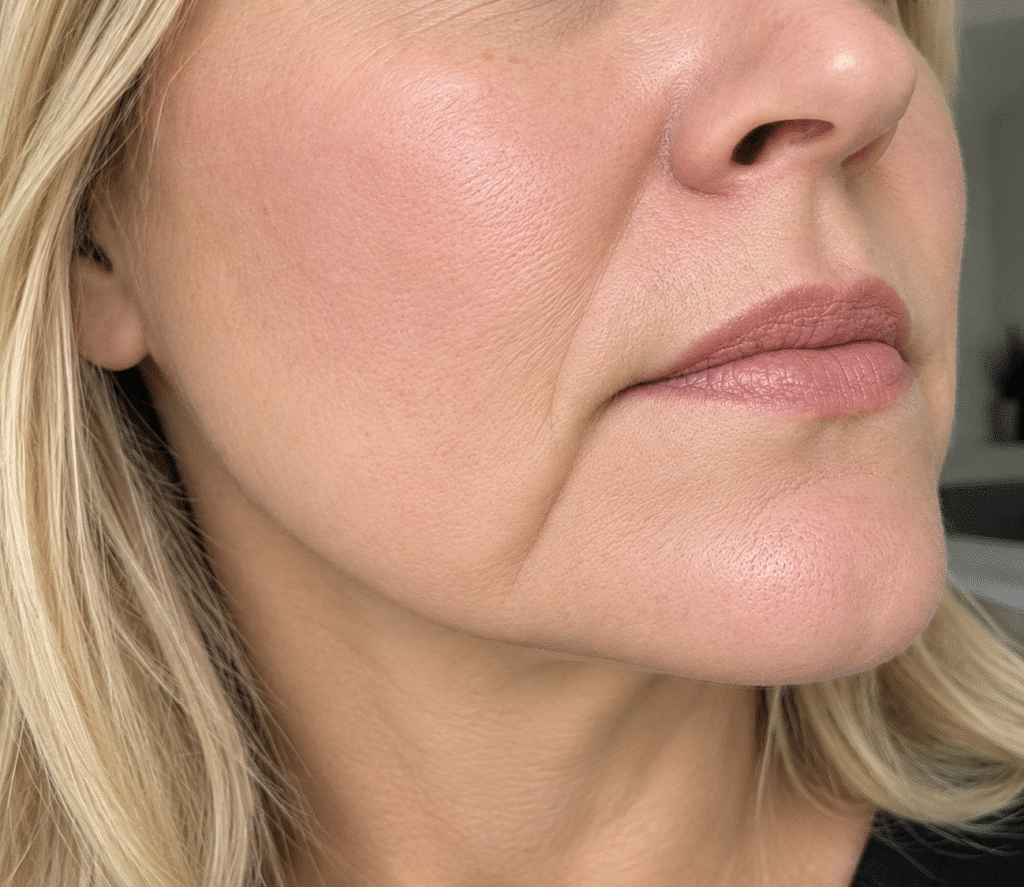
Marionette lines are caused by a combination of collagen loss, descending facial fat, and the repeated movement of the muscles around the mouth, which together create two vertical creases running down from the corners of the mouth towards the chin. The name comes from the hinged jaw of a marionette puppet, because the lines fall in roughly the same place as the puppet’s movable mouth.
The single biggest driver is the loss of structural support in the skin. From the mid-thirties onwards, and more sharply through the perimenopausal years, the skin produces less collagen and elastin, so it becomes thinner and less able to hold its shape. At the same time, the pads of fat that once sat high in the cheek begin to descend, and the sloping of the facial bones with age offers that soft tissue less support from beneath. Gravity does the rest, drawing everything downward and deepening the crease at the corner of the mouth.
Why Do Marionette Lines Form Where They Do?
Marionette lines form in a specific place for a specific reason: the corner of the mouth is a natural meeting point of movement, muscle and shifting volume. Every time you talk, eat or make an expression, the muscles around the mouth contract, and over decades those repeated folds etch themselves into skin that has less and less collagen to spring back with.
There is also a distinction worth drawing here, because it changes the treatment. Marionette lines run downward from the corners of the mouth towards the jawline, whereas the better-known nose-to-mouth lines, also called nasolabial folds, run from the sides of the nose to the corners of the mouth. The two are often mentioned together because they share many of the same causes, but they sit in
different places and sometimes call for a slightly different plan, which is why an assessment matters before anything is treated.
Can Marionette Lines Be Treated Without Surgery?
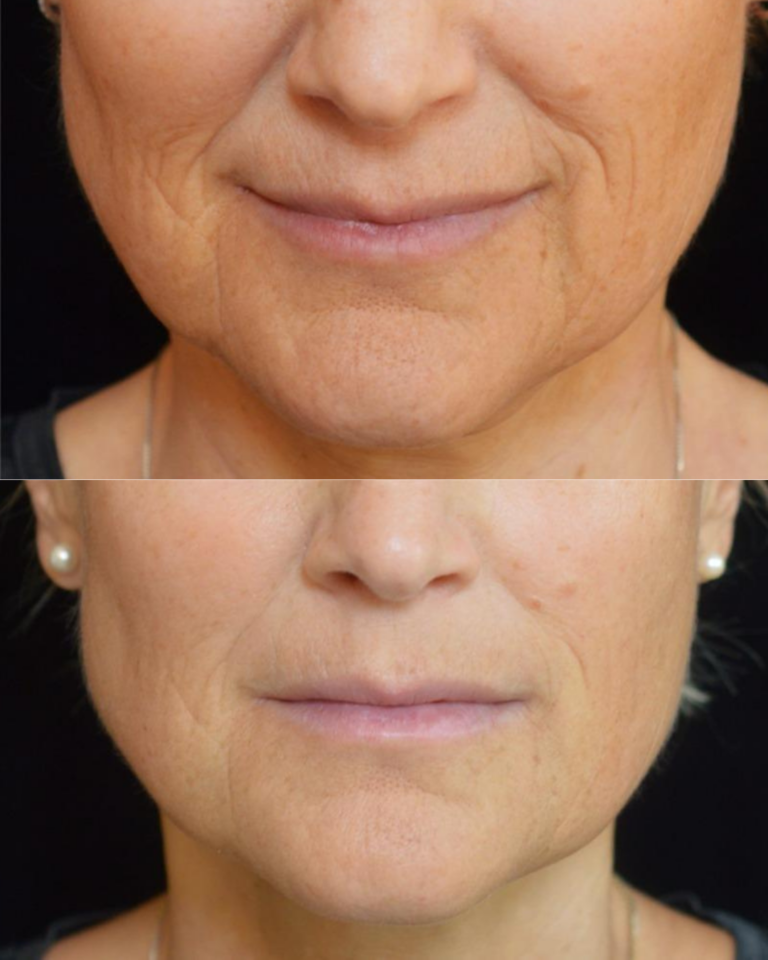
Yes, in most cases marionette lines can be significantly softened without surgery, particularly when they are caught before they become very deeply set. Because the root cause is usually a loss of the skin’s own structural support, the most effective non-surgical treatments are those that rebuild that support rather than simply masking the line. For lines that have become very deep, or where there is significant sagging of the lower face, a combination approach tends to work best, and realistic expectations are part of any good consultation.
The aim is not to freeze the face or to over-fill it into an unnatural smoothness. It is to restore enough support and firmness that the lines soften, and the lower face looks rested rather than drawn. This is where regenerative treatments, which prompt the skin to rebuild its own collagen, have changed what is possible.
JULÄINE™: Rebuilding the Support Beneath Marionette Lines
JULÄINE™ is particularly well suited to marionette lines, because it addresses the underlying cause rather than only the surface crease. It is a poly-L-lactic acid (PLLA) biostimulator, which means it does not fill or freeze anything. Instead, once it is introduced into the skin, the PLLA microparticles prompt a gentle, controlled response that recruits the skin’s own fibroblasts and gradually builds new collagen over the following weeks and months. The improvement you see is your own collagen, rebuilt, rather than an implanted volume.
This matters for marionette lines specifically. Because the problem is a loss of structural support in the lower face, a treatment that rebuilds that support from within tends to give a more natural, better-balanced result than simply filling the crease. JULÄINE™ softens deep folds, including marionette lines and nasolabial folds, while firming the surrounding skin, so the whole lower face looks more supported rather than just the single line being plumped.
It is administered with a fine cannula rather than a needle, which most patients find comfortable, and a topical numbing cream is available if preferred. Treatment is quick, with the procedure itself taking around fifteen to twenty minutes. Downtime is minimal, and any mild redness or swelling at the injection points usually settles within twenty-four to forty-eight hours.
How Long Do the Results Take, and How Long Do They Last?
Because JULÄINE™ works by stimulating your own collagen, the results appear gradually, which is rather the point. Most patients notice some initial tightening within the first few weeks, with the improvement becoming more pronounced over the following two to three months as new collagen forms. For the best outcome, we typically recommend a course of three treatments, spaced around 4-6 weeks apart, tailored to your face at consultation.
Once the full effect has developed, results typically last up to 2 years, though this varies with your skin type, age and lifestyle. If you would like a clearer sense of how a gradual, collagen-building result differs from the instant effect of a traditional filler, our comparison of JULÄINE™ and dermal fillers is a useful next read, as the right choice often comes down to how gradual a result you are looking for.
Supporting Your Results and Slowing New Lines
Whatever treatment you choose, a few habits protect the result and slow the formation of new marionette lines. Daily broad-spectrum SPF is the single most effective step, because ongoing sun exposure accelerates exactly the collagen loss that causes the lines in the first place. A considered skincare routine, good hydration and not smoking all support the skin’s structural health over time.
None of this reverses marionette lines on its own, but it protects the investment you make in treating them and helps your results last. Prevention and treatment work best hand in hand, rather than one standing in for the other.
Treating Marionette Lines at The Bronte Clinic
Softening marionette lines well depends on matching the treatment to what is causing them, which is why we always begin with an assessment rather than a fixed protocol. As a CQC-registered, medically led clinic, our team is led by Medical Director Dr Fiona McCarthy (MBChB, MRCP, PhD), and every treatment is delivered by one of our doctors or nurses. We look at the collagen quality, volume and movement of your lower face before recommending an approach built around you.
If marionette lines have begun to bother you and you would like to understand what can realistically be done, the most useful first step is simply to have them properly assessed. You can book a consultation at either our London or Surrey clinic, and we will help you find the right way to soften them and restore a more rested, supported lower face.