They go by many names – eleven lines, glabellar lines, worry lines – but whatever you call them, frown lines between eyebrows are one of the most common cosmetic concerns we see at The Bronte Clinic.
Those two vertical creases (sometimes three) that sit between your brows have a way of making you look stressed, angry, or tired, even when you feel none of those things. And if you have been watching them deepen over recent months or years, the frustration of looking in the mirror and seeing an expression that does not match how you feel is something you will understand immediately.
The good news is that frown lines between eyebrows are also one of the most treatable concerns in aesthetic medicine, provided you understand what is causing them and choose the right approach.
This article explains the anatomy behind these lines, why they deepen over time, which treatments are most effective, and when a single approach is enough versus when a combination delivers a better result.
Why Frown Lines Between Eyebrows Form
Understanding the anatomy is the first step to understanding the solution. Frown lines between eyebrows are created by the repeated contraction of two small but powerful muscle groups in the upper face.
The corrugator supercilii muscles sit above each eyebrow and pull the brows inward and downward – this is the movement you make when you frown, squint at a screen, or concentrate intensely. The procerus muscle runs vertically down the bridge of the nose and pulls the skin between the brows downward. Together, these muscles create the furrowing action that, over years of repetition, etches two vertical lines, or sometimes a horizontal crease, into the skin between your eyebrows.
In your twenties, these lines appear only when you actively frown and disappear the moment you relax. These are known as dynamic lines. Over time, however, the repeated folding of the skin in the same place, combined with the natural decline in collagen and elastin that comes with ageing, causes the creases to become permanently visible, even when your face is completely at rest. At this point, they have become static lines, and they require a different treatment strategy.
Several factors accelerate this transition. Genetics play a role – some people simply have stronger corrugator muscles or thinner skin in the glabellar area. Sun exposure breaks down collagen and accelerates skin ageing. Habitual expressions matter too; if you spend long hours concentrating at a screen, reading, or driving, the repeated micro-contractions add up significantly over time.
Anti-Wrinkle Injections: The First-Line Treatment for Frown Lines Between Eyebrows
For dynamic frown lines – those that appear when you frown but smooth out at rest – anti-wrinkle injections such as Botox® by way of example, remain the most effective treatment available. They are also the most well-evidenced, with decades of clinical research and millions of treatments performed worldwide.
Anti-wrinkle injections work by temporarily relaxing the corrugator and procerus muscles, reducing their ability to contract with the force that creates the furrowing movement. The result is a smoother, more relaxed appearance between the brows, without affecting your ability to express naturally. The goal is never to freeze the face. It is to soften the intensity of the movement enough that the skin is no longer being repeatedly creased.
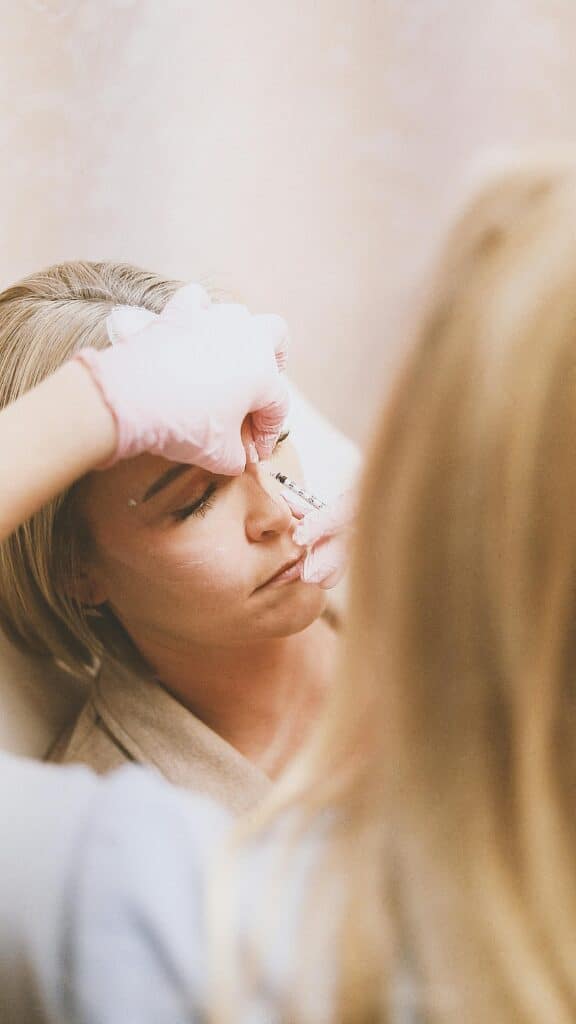
Treatment takes approximately fifteen minutes. A small number of precise injections are placed into the targeted muscles using an ultra-fine needle. Most patients describe minimal discomfort – just a brief pinch at each injection point. There is no downtime, and you can return to your normal workday activities immediately.
Results begin to appear within three to five days, with the full effect visible at around two weeks. The improvement typically lasts three to four months, at which point the muscle activity gradually returns and retreatment is recommended to maintain the result.
For patients whose frown lines between eyebrows are purely dynamic, anti-wrinkle injections alone are usually all that is needed. Regular treatment not only maintains a smooth appearance but can also have a preventative effect, by reducing the repetitive folding of the skin, the transition from dynamic to static lines is slowed significantly.
When Anti-Wrinkle Injections Alone Are Not Enough
If your frown lines between eyebrows are visible even when your face is at rest, you are dealing with static lines, and this is where a single treatment approach may fall short.
Anti-wrinkle injections will still help by preventing the lines from deepening further, but they cannot erase a crease that has already been physically etched into the skin. The line exists because the collagen and dermal structure in that area has been permanently folded and weakened. Relaxing the muscle above it stops the damage from continuing, but it does not reverse the damage that has already occurred.
This is where a combination approach becomes valuable. At The Bronte Clinic, we frequently pair anti-wrinkle injections with complementary treatments to address both the cause and the consequence of established frown lines between eyebrows.
Morpheus8 for Deeper Collagen Remodelling
For deeply etched static lines, Morpheus8 radiofrequency microneedling can stimulate collagen remodelling at a deeper level. By delivering controlled thermal energy into the dermis, Morpheus8 triggers the production of new collagen in the exact area where the skin has been structurally compromised. Over the weeks following treatment, the crease softens as the underlying tissue firms and regenerates.
When combined with anti-wrinkle injections, which prevent the muscle from continuing to fold the skin, Morpheus8 addresses the structural damage that already exists while anti-wrinkle injections protect against further deterioration. Together, they tackle both the cause and the consequence, delivering a more complete result than either treatment can achieve alone.
What To Do Before Deep Lines Set In
If you are beginning to notice faint frown lines between eyebrows that are just starting to linger after expression, the most effective step you can take is to address the habits and environmental factors that are accelerating the process.
Daily habits make a genuine difference. Wearing sunglasses reduces squinting – one of the most frequent and unconscious causes of glabellar muscle contraction. Adjusting screen brightness and position reduces prolonged frowning during concentrated work. A consistent skincare routine built around medical-grade SPF, retinoids, and antioxidants protects the collagen that keeps glabellar skin resilient. These are small interventions, but over a number of years they make a measurable difference.
If, despite these measures, you notice that lines are beginning to remain visible at rest, that is the point at which treatment becomes worth discussing. At The Bronte Clinic, our approach is always to start with non-injectable options first and to recommend anti-wrinkle injections only when they are genuinely warranted – not as a blanket preventative measure, but as a considered response to what your skin is actually showing us.
How We Approach Frown Lines at The Bronte Clinic
At The Bronte Clinic, we assess every patient’s frown lines between eyebrows individually before recommending a treatment plan. That assessment considers whether the lines are dynamic, static, or a combination of both. It takes into account the strength of the corrugator and procerus muscles, the thickness and quality of the skin, your age and treatment history, and your goals – whether that is complete smoothness, gentle softening, or simply prevention.
Our team, led by Medical Director Dr Fiona McCarthy (MBChB, MRCP, PhD), delivers every treatment within a consultation-first framework that ensures you receive a plan designed for your face, not a protocol applied to everyone.
Sometimes anti-wrinkle injections are all you need. Sometimes a combination delivers a more complete result. And occasionally, we will advise that the most effective use of your time and money is a good skincare routine and a pair of sunglasses. Whatever the recommendation, it will be honest.
Bothered by frown lines and unsure what will help? Book a consultation at The Bronte Clinic in London or Surrey, and let our team give you a clear, personalised assessment.