It often starts with a photograph. You see yourself laughing or squinting in natural light and notice, for the first time, that the fine lines fanning out from the corners of your eyes are no longer disappearing when your face relaxes. They are there in the mirror the next morning, faintly but unmistakably, even when you’re not smiling at all. If you have reached that moment, you are looking at crow’s feet, and you are almost certainly wondering which crow’s feet treatment will make a difference.
Crow’s feet are one of the earliest and most visible signs of facial ageing, and they are also one of the concerns patients feel most self-conscious about. Unlike lines on the forehead or between the brows, crow’s feet sit in an area you cannot easily conceal. They are on full display in every conversation, every smile, every photograph.
The good news is that they are also one of the most effectively treated concerns in aesthetic medicine. The right crows feet treatment can produce genuinely impressive results, provided you understand why they form and which approach is right for the stage they have reached.
Why Crow’s Feet Form and Why Crow’s Feet Treatment Requires a Specific Approach
The lines that radiate from the outer corners of your eyes are created by the orbicularis oculi – a thin, circular muscle that wraps around each eye like a ring. This muscle is responsible for closing the eyelids, squinting, blinking, and a significant part of how you smile. It is one of the most active muscles in the entire face, contracting thousands of times a day in movements you are rarely conscious of.
Every time the orbicularis oculi contracts, it gathers the skin at the outer corner of the eye into a fan of fine creases. In younger skin, those creases vanish the moment the muscle relaxes. But the skin around the eyes is the thinnest on the face, significantly thinner than the forehead or cheeks, with fewer oil glands and less subcutaneous fat to provide cushioning. This makes it uniquely vulnerable to the cumulative effects of repetitive movement.
Over time, the combination of constant muscular contraction and the natural decline in collagen and elastin that comes with ageing causes those temporary creases to become permanently etched into the skin. What were once dynamic lines, visible only during expression, become static lines that remain even when the face is completely at rest.
Several factors accelerate this process. Sun exposure is the single greatest contributor, breaking down the already fragile collagen in the periorbital area. Squinting, whether from bright light, poor vision, or screen use, dramatically increases the frequency of the muscle contraction. Smoking restricts blood flow to the skin and accelerates collagen degradation. And genetics determine the baseline thickness and resilience of your skin, meaning some people are simply more susceptible to crows feet than others.
Why Anti-Wrinkle Injections Are the Gold Standard Crow’s Feet Treatment
For dynamic crows feet, those that appear during smiling and squinting but smooth out at rest, anti-wrinkle injections like Botox are the most effective treatment available. No other non-surgical approach addresses the root cause of crow’s feet as directly or as predictably.
Anti-wrinkle injections work by temporarily relaxing the orbicularis oculi, reducing the force and frequency of the contractions that create the crinkling pattern. The muscle is not frozen, it is softened. You will still smile naturally, still express warmth and emotion through your eyes. What changes is the intensity of the gathering at the outer corners, which means the skin is no longer being repeatedly folded into the same creases.
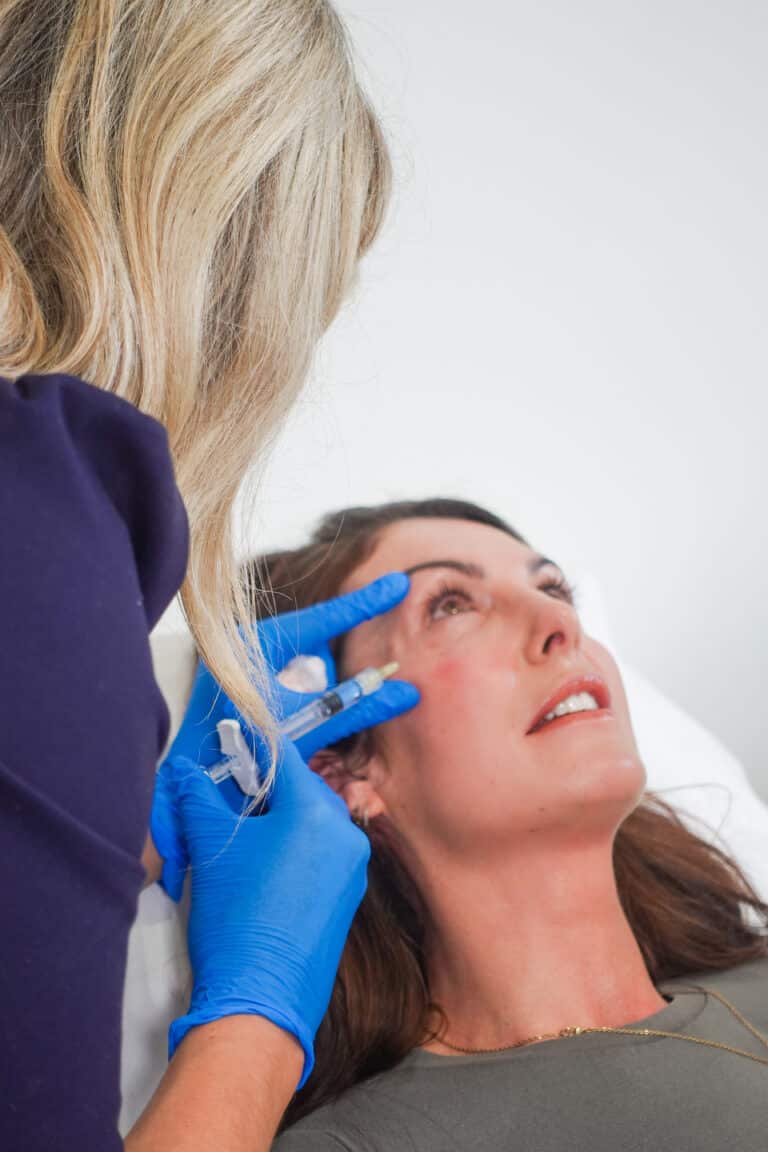
The treatment is quick, precise, and remarkably straightforward. A small number of injections are placed at carefully mapped points around the outer eye area using an ultra-fine needle. The procedure takes approximately five minutes, involves minimal discomfort, and requires no downtime – you can return to your day immediately.
Results typically begin to appear within three to five days, with the full effect visible at around two weeks. The improvement generally lasts three months in the crows feet area.
What Makes Crows Feet Different to Treat
Patients sometimes assume that if they are having anti-wrinkle injections for their frown lines, crows feet will respond in exactly the same way. In practice, there are important differences that affect both the approach and the expectations.
The orbicularis oculi is a broad, flat, circular muscle and is structurally very different from the small, powerful corrugator muscles that create frown lines. It requires a different injection pattern, different dosing, and a different understanding of how the muscle interacts with surrounding structures. Over-treating the orbicularis oculi can affect the natural shape of the smile, which is why precision and clinical experience matter significantly in this area.
The skin itself is also different. Because the periorbital skin is so thin, even subtle returning muscle movement can become visible here. This is one reason crow’s feet require a careful, conservative approach – overtreating this delicate area risks an unnatural or distorted appearance, so the focus is on balanced, precise dosing rather than simply chasing longevity.
When Anti-Wrinkle Injections Alone Are Not Enough
If your crow’s feet have progressed to the point where lines are visible at rest – static lines rather than purely dynamic ones – anti-wrinkle injections will prevent them from deepening further but may not fully smooth them away. The creases have been physically impressed into the skin through years of repetitive folding, and relaxing the muscle alone cannot reverse that structural change.
For these patients, a combination crow’s feet treatment approach delivers a more complete result.
Polynucleotides are particularly well-suited to the periorbital area. As injectable biostimulants that improve skin hydration, elasticity, and collagen production at a cellular level, they help to strengthen and regenerate the thin, fragile skin around the eyes, addressing the skin quality decline that allows static lines to form and persist. When paired with anti-wrinkle injections, polynucleotides work on the skin itself while the injections manage the muscle beneath it.
Morpheus8 radiofrequency microneedling can also be effective for crow’s feet that have become etched into the skin, stimulating deeper collagen remodelling in the periorbital area to gradually soften established creases.
The right combination depends on the depth and character of your lines, the quality of the surrounding skin, and how your face has responded to previous treatments, all of which are assessed during a consultation.
Prevention: Slowing Crow’s Feet Before They Set In
For patients who are noticing the very first signs of crow’s feet, there is a great deal you can do to slow the progression before treatment becomes necessary.
SPF, applied daily to the periorbital area, is your single most effective tool. The majority of visible skin ageing is driven by UV exposure, and the delicate skin around the eyes is especially vulnerable. Consistent daily protection preserves the collagen that is already there and defends against the environmental damage that accelerates fine lines. Worn every day, it will do more for the skin around your eyes than almost anything else.
Sunglasses are a valuable companion to SPF. They reduce squinting in bright light, which directly decreases the frequency of orbicularis oculi contraction – the primary mechanical cause of crow’s feet – while also shielding the periorbital skin from direct sun exposure. Beyond sun protection, retinoids and antioxidant serums support skin renewal and defend against free-radical damage. And simply being aware of habitual squinting – at screens, while driving, in conversation – can help you catch and reduce unconscious patterns that contribute to line formation over time.
When these measures are no longer sufficient and lines are beginning to remain at rest, that is the appropriate time to consider crow’s feet treatment with anti-wrinkle injections – not as a preventative measure applied too early, but as a considered response to what your skin is showing you.
How We Approach Crow’s Feet at The Bronte Clinic
At The Bronte Clinic, every crow’s feet treatment begins with a thorough assessment. Our team evaluates the activity and strength of the orbicularis oculi, the condition of the periorbital skin, whether your lines are dynamic, static, or a combination of both, and how the crow’s feet relate to other changes happening across the upper face.
This assessment ensures that the treatment plan is tailored to your face specifically – the correct dose, the correct placement, and the correct expectations for your individual anatomy and skin quality.
Our team, led by Medical Director Dr Fiona McCarthy (MBChB, MRCP, PhD), takes particular care with the periorbital area because of its anatomical complexity and its impact on how you express. Getting crow’s feet treatment right means preserving the warmth and character of your smile while softening the lines that are ageing your appearance. That balance requires clinical skill and experience, and it is something we take very seriously.
Bothered by crow’s feet and ready to do something about them? Book a consultation at The Bronte Clinic in London or Surrey for an honest, personalised assessment.